Key Messages
- The structure of actuarial work is stable. It already operates across reasoning, modeling, and workflows.
- AI does not add a new layer. It augments each existing layer differently.
- Reasoning becomes hybrid. Judgment is extended, challenged, and made explicit.
- Modeling becomes computer-aided. Models become reusable and continuously applied.
- Workflows become agent-organized. Execution is structured into systems that carry the work.
- The shift is structural. From one-off analysis to persistent, reusable systems.
- Accountability remains human. Augmentation strengthens governance rather than replacing it.
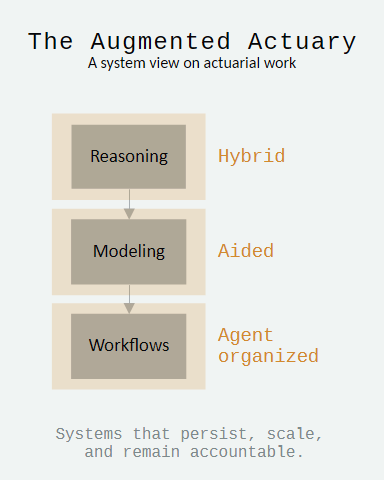
Actuarial work hasn’t changed as much as we think. At its core, it has always operated across three layers:
- Reasoning — reasoning about uncertainty
- Modeling — modeling it quantitatively
- Workflows — embedding it into workflows
What’s changing is not the structure, but how each layer is augmented.
- Reasoning becomes hybrid
→ thinking is extended, challenged, and made explicit - Modeling becomes computer-aided
→ models are not one-off, but continuously applied - Workflows become agent-organized
→ execution is structured into systems that carry the work
Not autonomous. But no longer purely manual either.
What this creates is a shift: From work that is performed once to work that is captured, reused, and carried forward. From thinking about doing to thinking about how it should be done.
Where this becomes practical
Across these areas, the question is no longer whether AI can be used —
but how it is embedded into reasoning, modeling, and workflows in a controlled way.
This is the work I focus on: making these layers explicit, connected, and operational — without losing accountability.
This is not theoretical — it shows up in very concrete places:
- Reserving / valuation
→ assumptions, adjustments, and reviews become explicit and repeatable
→ less dependency on individual cycles - Pricing & underwriting support
→ models become aware of state, trend, cycles, and experience
→ decision logic becomes transparent, reusable and well-timed - Risk & exposure management
→ scenario thinking becomes repeatable decision workflows
→ capital stays stable while preserving risk awareness - Reporting & governance
→ validation, accountability, and narratives are embedded
→ visuals and messages compound each reporting cycle
In all cases, the goal is the same:
not more models —
but better structured work
The way this is currently realized in practice is through integrating a structured agent framework into my agent factory, providing a consistent way to build, apply, and evolve systems that carry the work.
Executive takeaway
The actuary does not need a new role — the structure of the work is already in place.
What changes is the operating model:
- reasoning becomes hybrid
- modeling becomes computer-aided
- workflows become agent-organized
The result is not faster work, but more durable work:
- decisions improve because reasoning is clearer
- analytics scale because models are reusable
- execution stabilizes because workflows persist
The opportunity is simple:
turn actuarial work from something that is performed into something that continues to work.
I’m happy to discuss how this can be implemented in practice — and where it already starts to create value.
Tags: systems, architecture, governance, ai, applied-ai-systems