
Key Messages
- Directional effects matter. They tell you what influences what—a real decision signal.
- Trust is a separate layer. If assumptions fail, your conclusion can look precise while being unreliable.
- Stability is information, not noise. Clustering tells you how sensitive the system currently is.
- Business relevance is direct. Better trust and stability handling lead to safer and more profitable loss and capital decisions—especially in stressed regimes.
Why I reviewed it
I recently helped review a small time-series study on stress and physiology. The purpose was practical and personal: to understand the relationship between a psychological state and a physical stress marker over time. My role was limited and clear. I wasn’t there to redesign the study or to add a new modeling framework. I simply wanted to help within my competence and make sure the conclusions were defensible.
The question sounded simple: does one variable influence the other over time?
What we expected — and what actually happened
The initial hope was that the model would give a clean directional signal. Instead, the first pass produced contradictions:
- In one setup, the direction looked plausible—but the model assumptions behind the test were not met.
- In another setup, the direction disappeared—even though the coefficients looked “confident” in isolation.
- In a third setup, the direction flipped depending on what was included or left out.
This wasn’t a story of “the model is wrong.” It was a story of information loss and trust: the same data can appear to support direction, or not, depending on whether the system dynamics are represented and whether the test assumptions hold.
At that point, the main question changed from “Is there an effect?” to “Can we trust what the model is claiming?”
The hidden issue: the system was not equally stable over time
A simple diagnostic made the situation clearer. When we looked at the size of the errors over time, they did not look random and evenly spread. They came in clusters: calm phases with small swings, stressed phases with large swings, then calm again.
In other words, the system didn’t just have a level. It had a stress state that made it more or less sensitive. That is intuitive in human systems: when someone is calm, small triggers lead to small reactions; when someone is stressed, the same triggers lead to larger reactions. The stability of the system itself has memory, and the sensitivity state persists.
Many classical tests implicitly assume this is not happening. If that assumption is violated, the result can look crisp while the confidence is misleading.
A broader anchor: herding under stress—and the transfer to financial lines
This state-dependent sensitivity is not unique to physiology. Behavioral finance has long described herding: under stress, people react more strongly and start to follow each other’s behavior. Decisions become more synchronized, and volatility comes in waves.
Financial lines insurance has a close analogue. In calm periods, claims behavior can look stable. In stressed environments—economic downturns, litigation waves, or market shocks—defaults, lawsuits, and settlements can rise together. Reactions become aligned across many policies at once. Losses start to cluster.
So the volatility pattern in the study is not a technical nuisance. It is a signal of the system’s current sensitivity, and it has direct relevance for how we interpret directional results.
What we changed (and what we did not)
We did not redesign the model. Modeling a stress state explicitly would have gone beyond the task. But we did make one key move: we relaxed the “equally stable all the time” assumption and used a more robust, data-driven testing approach.
The directional story did not magically become significant. That wasn’t the goal. The goal was to make the inference valid, whichever way the result falls. A significant result from an invalid test or ignored signal is not evidence—it is bias disguised as confidence.
The three layers of value
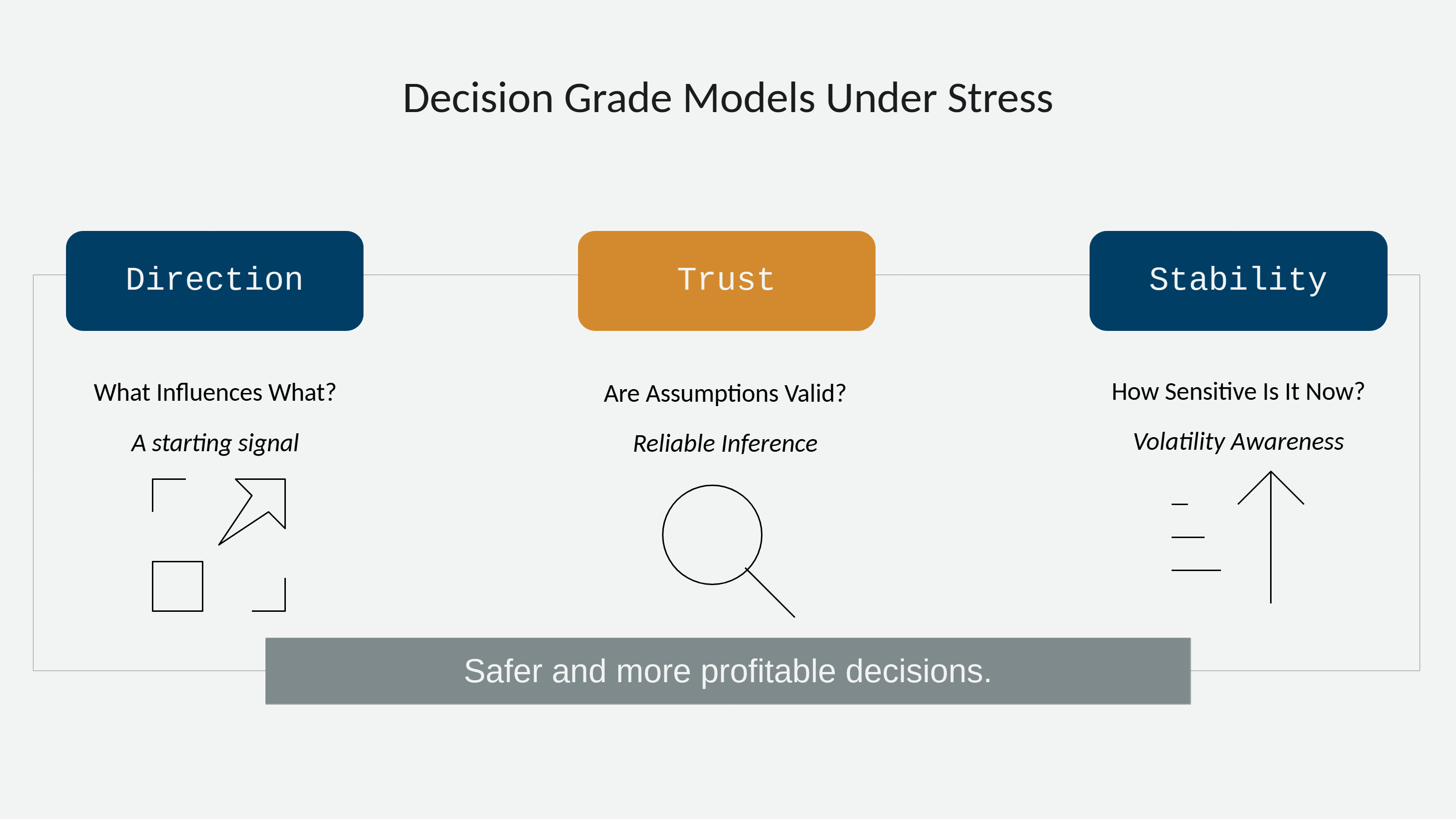
In the end, the review produced three distinct layers of value.
1) Direction
The model provides a directional signal: what influences what over time. That is real value and often the starting point for decisions.
2) Trust
Assumption checking is not a formality. It is governance. It tells you whether the directional result is decision-grade, or merely “nice to look at.”
3) Stability (future improvement)
Volatility clustering hinted at something deeper: the system behaves differently in calm and stressed phases. If that state is modeled explicitly later, you gain better prediction in all states because you are no longer forcing one sensitivity level onto the entire history.
Business implications: why this matters for losses and capital
This is not just an academic point. In insurance and risk management, we routinely ask directional questions: what drives losses, and what drives capital needs?
Direction is valuable—but direction without trust leads to over-confident actions. Direction without stability awareness often breaks precisely in stressed regimes, when decisions matter most.
The practical implication is simple:
- Safer decisions: you avoid building capital and risk actions on fragile results.
- More profitable decisions: you stop paying for false precision and can deploy risk capacity where it is genuinely rewarded.
Stability awareness doesn’t reduce ambition. It reduces avoidable error.
Executive takeaway
Directional results are useful, but the decision value comes from the next two questions:
- Can we trust the result?
- How sensitive is the system right now?
When you add trust and stability awareness, you don’t just get a model that explains the past. You get one that remains defensible—and useful—when the system moves into a stressed state.
Tags: risk, insurance, exposure-management, capital-management, governance, analytics