As a sporting director, I’m not looking for more statistics. I’m looking for clarity.
Predictive intelligence helps me understand where we truly stand, how our season is shifting, and what decisions are becoming unavoidable.
Key messages
- Expected league position filters out noise and reveals our real competitive level.
- Probability trajectories show whether the season is stabilising or drifting.
- Squad dashboards explain why results happen and where structural weaknesses lie.
- Predictive modelling improves communication, planning and decision-making across the club.
- xGs are silver, xPs are gold.
1. Expected position — a clearer league table
I use the expected end-of-season position as the first anchor for discussions with coaches, the board, and scouts.
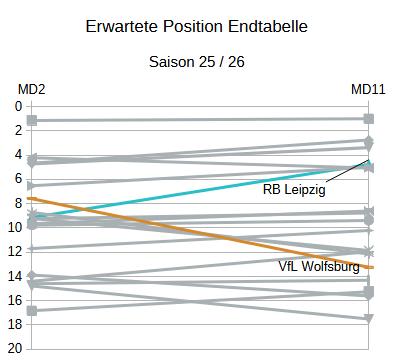
Here, Leipzig stabilises upward while Wolfsburg drifts downward; a reminder that results and underlying performance often diverge. This informs tone, expectations and the urgency of interventions.
2. Probability trajectories — how the season is really unfolding
Trend lines matter more than snapshots.
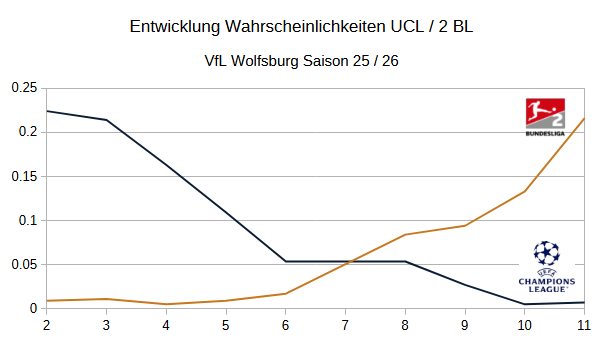
Wolfsburg’s falling UCL probability and rising relegation risk tell a simple story: the early view and current performance of the squad is diverging, and course-correction becomes a strategic necessity.
I rely on these curves to judge whether we stay on plan or need to adjust.
3. Deep squad view — understanding why results happen
This VfB dashboard illustrates how structural insight replaces guesswork.
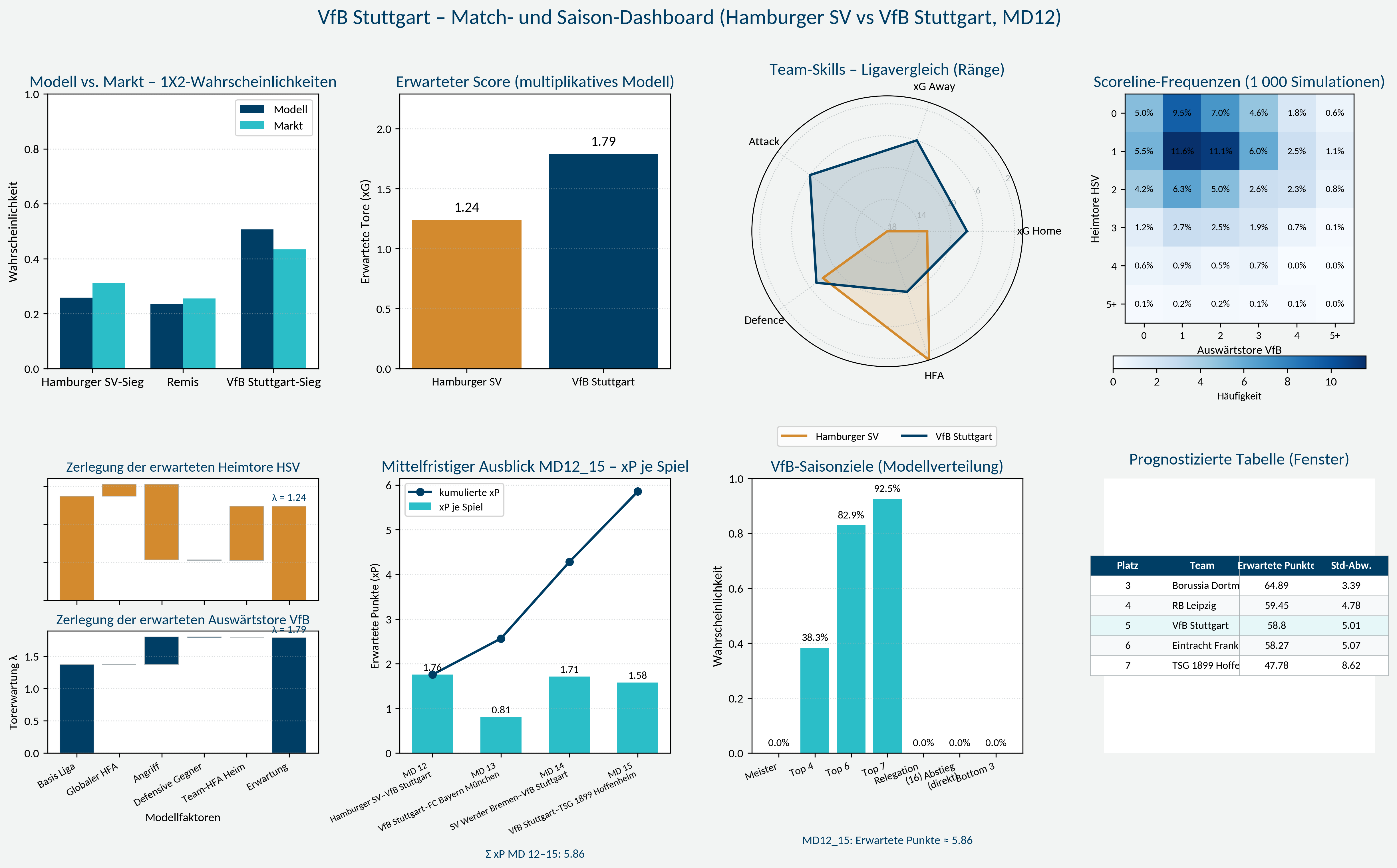
Key signals I look for:
- Expected score vs market assessment - my look in the mirror to truly understand external perception
- Squad strengths and weaknesses (attack, defence, home/away profile) - who am I, how strong is my competitor
- Scenario probabilities (Top 6, relegation, mid-table) - am I still on track, to separate the heat of the moment from my management objectives
- Expected-points outlook for the next fixtures - how do I navigate the immediate future
- Final table - move away from 6-points-game now, to truly understand who am I competing with currently
These views align conversations with coaching staff and support decisions on rotation, recruitment and development. The coach can adapt and simulate strategies (squad choice and tactical formation).
4. What predictive intelligence enables
In daily practice, it gives me:
- A neutral, model-based view of squad quality
- Early detection of performance drift
- Better planning for finance, budgeting, contracts, transfers and coaching
- More credible communication with board, owners and supporters
Predictive intelligence doesn’t remove uncertainty — it gives it structure.
Conclusion
Football is chaotic in the short run but structural in the long run. As a sporting director, I use predictive models to understand those structures, anticipate inflection points and make decisions before problems become visible in the table.
The truth is on the pitch — but the future becomes visible in the model.
Tags: sports, analytics, leadership