What is artificial intelligence? Why the hype? How is it used?
According to ISO/IEC 22989:2022,
Artificial Intelligence (AI) is the capability of a system to acquire, process, and apply knowledge and skills to achieve specific goals in a given environment.
AI aims to replicate — or augment — human cognitive abilities such as learning, reasoning, and perception. Over time it has evolved from rule-based reasoning to data-driven and generative systems.
A Structure of Intelligence
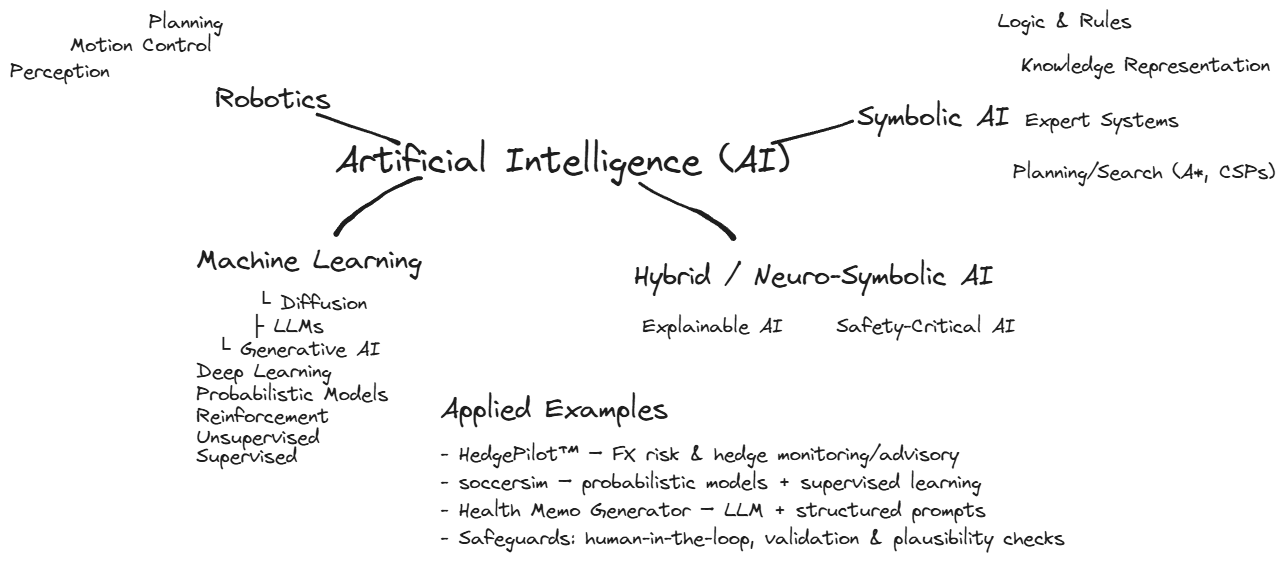
Structure of Artificial Intelligence — from reasoning to learning to generation
Symbolic AI, or classical AI, expresses logic through explicit rules — expert systems such as MYCIN or Deep Blue are early examples.
Robotics builds on these principles, combining sensing, motion, and planning — often enhanced by learning.
Machine Learning replaced rules with data patterns, from supervised and probabilistic models to deep learning — the basis for today’s Generative AI, capable of producing new, context-aware output.
Hybrid or neuro-symbolic AI blends logic and learning for explainable and safety-critical applications.
The current hype around AI is from generative AI being accessible and, at the surface, understandable to the mainstream. To give some credit, it also opens new use cases within applications, such as the LLM based Health Memo Generator.
Modern autopilot systems in aviation are among the most advanced real-world examples of hybrid AI, combining rule-based logic for certified safety with learning components for adaptive control—demonstrating how intelligence can evolve within trusted boundaries. This is generally accepted by every passenger entering the airplane; even by my son, with whom I watched plain spotter videos in storm Benjamin today.
The Actuary’s View — AI and Quantitative Reasoning
In finance and insurance, AI is hardly new. Tools like AAAccell’s HedgePilot™ — a risk and hedge monitoring and advisory platform for FX exposure — or my Soccersim application, combining probabilistic modeling with supervised learning AI supports professionals in applied analytics.
Less controversial systems rest on the pillars of quantitative reasoning: transparency, reproducibility, and interpretability — ensuring that human judgment stays central. But some methods spark fundamental controversy. Why?
Responsible Use and Human Oversight
The real issue is not whether AI should be used, but how it is deployed. Implemented safeguards are essential; a simple baseline is human-in-the-loop — final decisions always rest with people, assisted by AI engines.
AI can also help validate and explain AI — generating human-readable validation reports, surfacing likely errors, performing plausibility checks, or distilling complex models into key factors. Such meta-use builds trust and accountability in professional environments, as well with regulators.
From Reasoning to Creation
AI’s path from rules to generation mirrors analytical progress itself — define, measure, create. Its true potential lies in experts deploying this general-purpose technology to domain-specific problems, as Prof. Charles-Albert LeHalle remarked at FX Trade Tech. It continues a decades-long trend under one enduring word: digitalization.
Tags: ai, applied-ai-systems, precision-ai