Most organisations were designed for a time when the world was stable — when direction came from the top, execution from below, and change moved slowly enough to plan. How have market leaders adapted already?
Today, advantage comes from learning faster than the environment changes. For GenZ, this thinking is even native; anything non-participative gets rejected.
That’s why I see Purpose, Collaboration, and Innovation not as management slogans, but as the living system behind modern leadership.
This is particularly important in transformations, as I have often seen cracks appear in leadership models that are rule-based, top-down, static, and obligation-driven.
Also, this spirit is key DNA of companys that aspire itself leadership positions, which became clear to me, when visiting Trek Bycycle Corporation a while ago.
Purpose, Collaboration, Innovation — the interactive core
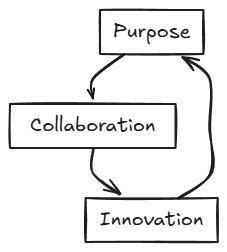
Purpose–Collaboration–Innovation: the interactive core
Purpose gives orientation when structures can’t.
It defines why we exist — creating clarity, identity, and direction without requiring constant supervision.
Collaboration turns purpose into motion.
It’s how people connect across boundaries, act with autonomy, and still pull in the same direction.
It transforms compliance into co-creation.
Innovation keeps the system alive.
When purpose guides and collaboration energises, innovation emerges naturally — not as a department, but as an organisational reflex.
Together they form a loop, not a line: self-correcting, self-energising, and built for coherence rather than control.
Why it works
The Purpose–Collaboration–Innovation loop works because it’s designed as an interactive, adaptive system rather than a linear hierarchy.
Its design logic is based on feedback and learning — not static layers or plans.
Information flows freely across and upward, allowing insight to travel faster than instruction ever could.
Control shifts from external enforcement to internal coherence: people act responsibly because they understand the shared purpose, not because someone monitors them.
The energy source is intrinsic — meaning, curiosity, and contribution replace compliance as the primary driver.
Its tempo is dynamic and iterative; instead of waiting for annual strategies or project cycles, the organisation adjusts in real time as collaboration and innovation continuously refresh direction and action.
And the outcome is resilience through renewal — a system that learns, corrects, and evolves without needing to be rebuilt each time the environment changes.
A quiet warning
Many management systems still rely on Mandate–Organisation–Culture as their operating model.
Clear on paper — but often slow, fragile, and detached from where value is actually created.
They separate design from practice, policy from learning, and culture from experience.
The alternative isn’t chaos — it’s coherence through interaction.
One is easy to implement: you can write it down.
The other is hardly worth writing down — but infinitely harder to achieve, though not impossible.
So the question is:
Are you still managing in Mandate–Organisation–Culture models — or already leading through Purpose, Collaboration, and Innovation?
Tags: governance, strategy, leadership, transformation